Metal Forming Practise: Processes - Machines - Tools
Chapter 10: Wire Drawing

10.1 Definition

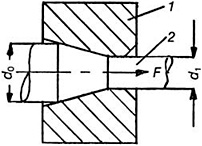
Wire drawing is a form of drawing using a sliding action (Figure 10.1) where a wire of a larger size ( d 0) is pulled through a drawing ring of a smaller size ( d 1). In this process the wire is given the shape and the cross-sectional dimensions of the drawing ring. Wire drawing belongs to the production processes which involve forming by tensile and compressive forces, as a state of stress develops in the deformation zone due to deformation by both tension and pressure. In wire drawing, a difference is made according to the dimensions of the wire between:

coarse drawing:

d = 16 to 4.2 mm

medium drawing:

d = 4.2 to 1.6 mm

fine drawing:

d = 1.6 to 0.7 mm

ultra-fine drawing:

d < 0.7 mm

and according to the machine used, between:

  • single-draft drawing

  • tandem drawing.


Figure 10.1: The principle of wire drawing. 1 die, 2 wire

10.2 Application

Wire and rod drawing are used to produce wires and rods with smooth surfaces and low tolerances for various fields of application (Table 10.1).

Table 10.1: Fields of application of drawn wires and rods

Material

Application

Low-carbon steels, C 10 C22

Wires, wire meshes, barbed wire, pins, nails, screws and bolts, rivets

High-carbon steels (up to 1.6% C)

Rod material for automatic processing, wire cables

Alloy steels

Industrial springs, welding wires

Copper...

UNLIMITED FREE
ACCESS
TO THE WORLD'S BEST IDEAS

SUBMIT
Already a GlobalSpec user? Log in.

This is embarrasing...

An error occurred while processing the form. Please try again in a few minutes.

Customize Your GlobalSpec Experience

Category: Rolled Metals and Drawn Metals
Finish!
Privacy Policy

This is embarrasing...

An error occurred while processing the form. Please try again in a few minutes.