Metal Forming Practise: Processes - Machines - Tools
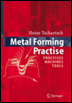
Part II: Presses

Chapter List

Chapter 21: Types of Press
Chapter 22: Hammers
Chapter 23: Screw Presses
Chapter 24: Eccentric and Crank Presses
Chapter 25: Knuckle-Joint and Toggle Presses
Chapter 26: Hydraulic Presses
Chapter 27: Special-Purpose Presses
Chapter 28: Workpiece and Stock Feed Systems
Chapter 29: Future Developments in Metal Forming Presses and Tool Changing Systems

According to their characteristics, presses can be classified into those controlled mainly by work (energy), the ram path or force.

21.1 Presses Controlled by Work

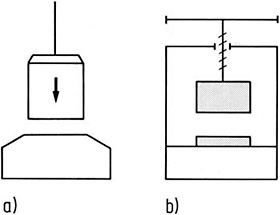
Hammers and screw presses are machines whose main characteristic is their work capacity (energy). A hammer s work capacity is determined from the ram mass and drop height. With screw presses, the work capacity is stored in the rotating masses (mainly in the flywheel), therefore it depends upon the angular velocity and the mass moment of inertia. The two kinds of machine are similar in that the work capacity can be influenced or adjusted.

The force, on the other hand, can not be directly adjusted, but depends upon the kind of work-piece and the deformation distance.


Figure 21.1: The principle of presses controlled by work, a) drop hammer, b) screw press

21.2 Presses Controlled by the Ram Path

These include crank presses and knuckle-joint presses. With these presses, the deformation is complete when the ram has reached its lowest position (bottom dead centre BDC). This means their characteristic value is the ram path limit, which comes from the crank radius r in crank presses and from the leverage with knuckle-joint presses...

UNLIMITED FREE
ACCESS
TO THE WORLD'S BEST IDEAS

SUBMIT
Already a GlobalSpec user? Log in.

This is embarrasing...

An error occurred while processing the form. Please try again in a few minutes.

Customize Your GlobalSpec Experience

Category: Tableting Presses
Finish!
Privacy Policy

This is embarrasing...

An error occurred while processing the form. Please try again in a few minutes.