1.10.1 State Transition Matrix
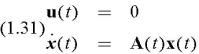
The state equation of a linear time-varying system is given by
For a homogeneous (unforced) system
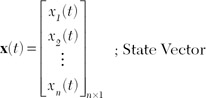
and, A( t) = n n matrix whose elements are continuous functions of t in the interval t to t.
The solution of the linear time-varying homogeneous state Equation (1.31) is given by
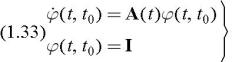
where ( t, t 0) is the n n nonsingular matrix satisfying the matrix differential equation
where (t, t 0 ) is called the State Transition Matrix for the linear time-varying system described by Equation (1.31).
For time-varying systems, the state transition matrix depends upon bothi and i 0 and not on the difference t t 0. It is important to note, however, that the state transition matrix for a time-varying system cannot, in general, be given as a matrix exponential. The state transition matrix (t, t 0) is given by a matrix exponential if, and only if, A(t) and  commute,
i.e., if, and only if, A(t) and  commute; the STM is given by
Note that, if A(t) is a constant matrix or diagonal matrix, A (t)  commute. However, if A (t) and
  do not commute, there is no simple way to compute STM.
In order to compute (t, t 0) numerically, we have the following...

 TABLE OF CONTENTS