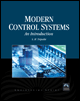
Modern Control Systems: An Introduction
The methods of analysis and the design of feedback control systems; such as root locus, and Bode and Nyquist plots, require the physical system to be modelled in the form of a transfer function. Although the transfer function approach of analysis is a simple and powerful technique, it suffers from certain drawbacks:
The transfer function model is only applicable to linear time-invariant systems.
A transfer function is only defined under zero initial conditions; meaning that the system is initially at rest and the time solution obtained is, in a general form, due to input only. However, for multi-input-multi-output, the systems are initially not at rest. Hence, as a conclusion, the transfer function model is generally restricted to single-input-single-output (SISO) systems.
A transfer function technique only reveals the system output for a given input and does not provide any information regarding the internal state of the system.
Thus, the classical design methods (root locus and frequency domain methods) based on the transfer function approach are inadequate and not convenient.
The limitations listed above made us feel the need for a more general mathematical representation of a control system, which, along with the output, yields information about the state of the system-variables at some predetermined points along the flow of signals. This leads to the development of the state-variable approach, which has the following advantages over the classical approach:
It is a direct time-domain approach. Thus, this approach is suitable for digital computer computations.
It...