Motor Control Electronics Handbook
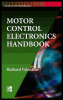
This up-to-the-minute guide provides you with motor control fundamentals and progressive design tips, as well as the latest in electronics technology.
 TABLE OF CONTENTS
 Randy Frank
Motorola Semiconductor Products
Electric motors, widely used throughout our industrial society in factories and homes, have been evolving for several decades. In this chapter, we will discuss various ways in which electronics technology will further the evolution of motors.
Recent advances in high-energy batteries, combined with the development of smaller and more powerful motors, have opened new markets for a wide range of products, including portable appliances, entertainment equipment, and electric vehicles. The convenience of devices such as portable drills, weed cutters, and other rotating tools has resulted in the rapid growth of motor controls. The newest laser-based audio equipment [compact disks (CDs)], digital audio tape (DAT) and cameras of all kinds, including still, video, and the newest digital versions require sophisticated, high-performance motion control systems. One emphasis for new designs has concentrated on low power consumption in order to extend battery life, providing longer hours of operation.
Designers' concerns, however, for improved performance and more efficient operation are not limited to portable applications. The next generation of motors in many stationary applications will take further advantage of changes that are occurring in both the motors and the drive electronics that control and protect them. Motor drive electronics is experiencing improvements in the packaging, control, and power, as well as in the interconnectivity and communication that will allow motors to run more efficiently, adapt to new applications more quickly, and operate...