Motor Control Electronics Handbook
This up-to-the-minute guide provides you with motor control fundamentals and progressive design tips, as well as the latest in electronics technology.
 TABLE OF CONTENTS
 Warren Schultz
Motorola Semiconductor Products
In motion control systems much design time is typically devoted to electrical noise management. In this chapter, we will discuss various techniques that make the nuts and bolts of noise management easier, reducing the need to redesign and debug a motor drive system. Many of these techniques provide electrical noise robustness at the expense of some additional component cost. ( Editor's note: Power control engineers use the term robustness to indicate ability to withstand stress from outside sources, such as voltage transients, electrical noise, thermal cycling, and current peaks). The benefits of increasing electrical noise robustness include reduced development cost, faster time to market, and a higher likelihood of trouble-free operation in the field.
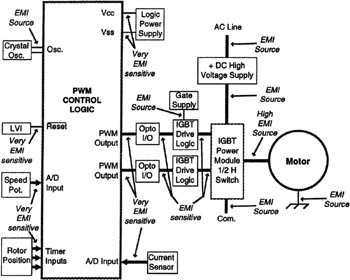
Circuit design can have a profound influence on both the amount of electrical noise produced and the susceptibility of motor drive circuits to the noisy environments in which they operate. Figure 7.1 is a block diagram showing some of the most troublesome noise areas in a motor drive. Most of the electrical noise is generated from the motor's electronic power stage. In the following discussion we will examine N-channel output stages, complementary output stages, and controllers.