Motor Control Electronics Handbook
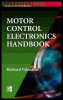
This up-to-the-minute guide provides you with motor control fundamentals and progressive design tips, as well as the latest in electronics technology.
 TABLE OF CONTENTS
 Richard J. Valentine
Motorola Semiconductor Products
In the preceding chapter it should have become apparent that electric motors are employed in a wide variety of applications and that many of these applications are evolving from electromechanical to electronic designs. As will be seen in this chapter and the chapters that follow, electronic motor circuits interface easily with digital logic. An obstacle to wide-scale use of electronic motor controls has been the high cost of the control computer and power electronics. This obstacle is diminishing as the semiconductor industry improves the technology of microcomputers and power devices.
In this chapter we deal with many of the issues that affect the electronic design of motor controls. Reliable electronics for a motor control requires careful attention to the effects of factors such as inductance, excessive temperatures, short circuits, and locked rotor conditions. Products that are specifically rated or designed for motor control applications minimize potential risks. The design criteria shown in this chapter and following chapters can be applied to many different types of motor control designs.
Following are a few notes about the technical aspects of the materials presented here. Crucial specifications or values are noted and need to be heeded when contemplating an electronic motor design. Items that affect the long-term reliability or stability of the electronic motor design are italicized. The authors are writing primarily from experience and an applications vantage; they know how to make something work and which details, on the basis of actual lab testing,...