Motor Control Electronics Handbook
This up-to-the-minute guide provides you with motor control fundamentals and progressive design tips, as well as the latest in electronics technology.
 TABLE OF CONTENTS
 Richard J. Valentine, Peter Pinewski, and Thomas Huettl
Motorola Semiconductor Products
Electric-powered vehicles use a variety of motor drive systems. The most common has been a field wound DC brushed motor. The recent introduction of purpose-built electric vehicles indicates that both AC induction and BLM motors are gaining in popularity for traction motor application. Hybrid vehicles also use electric motors with internal-combustion engines (ICE) and, in some cases, an ICE-powered alternator or flywheel mechanism.
This chapter reviews DC and AC motor drive designs for electric vehicles. These designs are based on motor drive research and a conversion test vehicle (a 1993 Dodge Dakota midsize truck). One of the main differences between a vehicle powered by an electric motor and a standard ICE is that the electric motor provides high torque at very low rpm. The series-wound DC motor produces very high starting torque, while an AC induction motor with vector control, in addition to providing high starting torque, can also continue to supply that torque level at higher rpm than can the DC series motor.
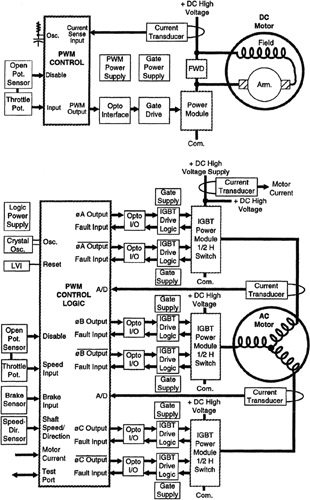
Figure 6.1 shows both the basic DC and AC motor drive systems. The DC brushed motor system is undoubtedly the easiest to implement. The AC motor system, on the other hand, is more complex but offers higher performance. The DC motor design can use linear control ICs, while the AC vector control motor requires a high-performance MCU or a custom ASIC device.
The EV motor and drive...