PCI Express Electrical Interconnect Design: Practical Solutions for Board-level Integration and Validation
Frequency domain analysis is well-suited for simulating and validating a PCI Express interconnect channel at either the system platform or package level. Compared to time domain analysis, frequency domain analysis offers the following advantages:
Easier simulation and validation processes using vector network analyzer VNA data
A solid and robust method of finding the worst-case pattern of the crosstalk coupling and power delivery
Shorter simulation process time, compared with the number of time domain simulation runs
Calculation of the desired output S-parameter data such as loss and reflection over the frequency range of operation
Testing S-parameter outputs against the frequency data specifications
Frequency domain analysis provides an easy method for combining the cascaded electrical segment components, yielding the end-to-end characteristics of the system platform. The output data of the frequency domain analysis is an S-parameter matrix that is measured for passive electrical structure. S-parameter data can characterize the passive electrical structures with such quantities as reflection coefficient (Bansal 2004), insertion loss, and input impedance. S-parameter data can also characterize the interaction coupling between the signal pairs at both near and far ends of the interconnect platform, known as near-end crosstalk (NEXT) and far-end crosstalk (FEXT), respectively.
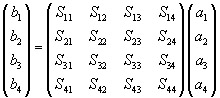
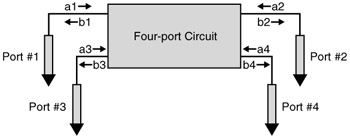
Figure 4.1 presents a single-ended four-port interconnect system that can be characterized by a 4 4 S-parameter data matrix, as follows.
| (4.1) 4 4 S-parameter Data Matrix | |
As shown in Figure 4.1, S-parameter matrix data define the transmitted power and the reflected voltage at each end of...