Probability and Random Processes for Electrical and Computer Engineers

In the previous section, we discussed how a computer maker might determine if one of its suppliers provides more reliable devices than the other. We said that if the relative frequency of working chips from supplier S1 is substantially different from the relative frequency of working chips from supplier S2, we would conclude that one supplier is better than the other. On the other hand, if the relative frequencies of working chips from both suppliers are about the same, we would say that whether a chip works not does not depend on the supplier.
In probability theory, if events A and B satisfy P( A B) = P( A B c), we say A does not depend on B. This condition says that
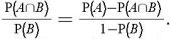
Applying the formulas P( B c) = 1 ? P( B) and
to the right-hand side yields
Cross multiplying to eliminate the denominators gives
Subtracting common terms from both sides shows that P( A ? B) = P( A) P( B). Since this sequence of calculations is reversible, and since the condition P( A ? B) = P( A) P( B) is symmetric in A and B, it follows that A does not depend on B if and only if B does not depend on A.
When events A and B satisfy
we say they are statistically independent, or...