9.1 Introduction
Scalar Gaussian or normal random variables were introduced in Chapter 4. Pairs of Gaussian random variables were introduced in Chapter 7. In this chapter, we generalize these notions to random vectors.
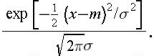
The univariate N( m, ? 2) density is
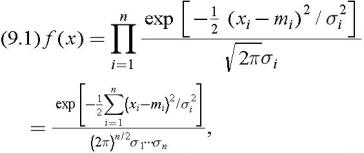
If X 1, , X n are independent N( m i,  ), then their joint density is the product
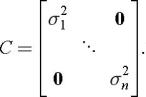
where x := [ x 1, , x n] ?. We now rewrite this joint density using matrix vector notation. To begin, observe that since the X i are independent, they are uncorrelated; hence, the covariance matrix of X := [ X 1, , X n] ? is
Next, put m := [ m 1, , m n] ? and write
It is then easy to see that  . Since C is diagonal, its determinant is
  . It follows that (9.1) can be written in matrix vector notation as
Even if C is not diagonal, this is the general formula for the density of a Gaussian random vector of length n with mean vector m and covariance matrix C.
One question about (9.2) that immediately comes to mind is whether this formula integrates to one even when C is not diagonal. There are several ways to see that this is indeed the case. For example, it can be shown that the multivariate...


 TABLE OF CONTENTS