Probability and Random Processes for Electrical and Computer Engineers

Chapter 2: Introduction to Discrete Random Variables

Overview

In most scientific and technological applications, measurements and observations are expressed as numerical quantities. Traditionally, numerical measurements or observations that have uncertain variability each time they are repeated are called random variables. We typically denote numerical-valued random quantities by uppercase letters such as X and Y. The advantage of working with numerical quantities is that we can perform mathematical operations on them such as


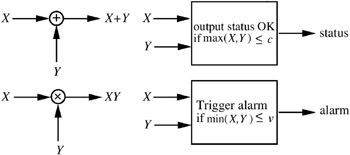
For example, in a telephone channel the signal X is corrupted by additive noise Y. In a wireless channel, the signal X is corrupted by fading (multiplicative noise). If X and Y are the traffic rates at two different routers of an Internet service provider, it is desirable to have these rates less than the router capacity, say c; i.e., we want max( X , Y) ? c. If X and Y are sensor voltages, we may want to trigger an alarm if at least one of the sensor voltages falls below a threshold v; e.g., if min( X , Y) ? v. See Figure 2.1.


Figure 2.1: Systems represented by operations on random variables.

In order to exploit the axioms and properties of probability that we studied in Chapter 1, we technically define random variables as functions on an underlying sample space ?. Fortunately, once some basic results are derived, we can think of random variables in the traditional manner, and not worry about, or...

UNLIMITED FREE
ACCESS
TO THE WORLD'S BEST IDEAS

SUBMIT
Already a GlobalSpec user? Log in.

This is embarrasing...

An error occurred while processing the form. Please try again in a few minutes.

Customize Your GlobalSpec Experience

Category: Inertial Sensor Chips
Finish!
Privacy Policy

This is embarrasing...

An error occurred while processing the form. Please try again in a few minutes.