In the previous chapter, we worked mostly with two or three random variables at a time. When we need to work with a larger number of random variables, it is convenient to collect them into a column vector. The notation of vectors and matrices allows us to express powerful formulas in straightforward, compact notation.
8.1 Review of Matrix Operations
Transpose of a matrix. Recall that if A is a matrix with entries A ij, then its transpose, denoted by A ?, is defined by ( A ?) ij := A ji. For example,
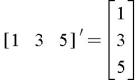
The transpose operation converts every row into a column, or equivalently, it converts every column into a row. The example
shows that an easy way to specify column vectors is to take the transpose of a row vector, a practice we use frequently.
Sum of matrices. If two matrices have the same dimensions, then their sum is computed by adding the corresponding entries. For example,
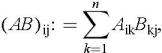
Product of matrices. If A is an r n matrix and B is an n p matrix, then their product is the r p matrix whose entries are given by
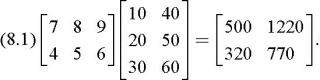
where i = 1, , r and j = 1, , p. For example, using a piece of scratch paper, you can check that
You can also check it with the MATLAB...


 TABLE OF CONTENTS