Probability and Random Processes for Electrical and Computer Engineers

1.4: Axioms and properties of probability
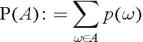
Note 1. When the sample space ? is finite or countably infinite, P( A) is usually defined for all subsets of ? by taking
for some nonnegative function p that sums to one; i.e., p( ?) ? 0 and ? ??? p( ?) = 1. (It is easy to check that if P is defined in this way, then it satisfies the axioms of a probability measure.) However, for larger sample spaces, such as when ? is an interval of the real line, e.g., Example 1.16, and we want the probability of an interval to be proportional to its length, it is not possible to define P( A) for all subsets and still have P satisfy all four axioms. (A proof of this fact can be found in advanced texts, e.g., [3, p. 45].) The way around this difficulty is to define P( A) only for some subsets of ?, but not all subsets of ?. It is indeed fortunate that this can be done in such a way that P( A) is defined for all subsets of interest that occur in practice. A set A for which P( A) is defined is called an event, and the collection of all events is denoted by
. The triple ( ?,
, P) is called a probability space. For technical reasons discussed below,...