Probability and Random Processes for Electrical and Computer Engineers
The two most important continuous-time random processes are the Poisson process and the Wiener process, which are introduced in Sections 11.1 and 11.3, respectively. The construction of arbitrary random processes in discrete and continuous time using Kolmogorov s theorem is discussed in Section 11.4.
In addition to the Poisson process, marked Poisson processes and shot noise are introduced in Section 11.1. The extension of the Poisson process to renewal processes is presented briefly in Section 11.2. In Section 11.3, the Wiener process is defined and then interpreted as integrated white noise. The Wiener integral is introduced. The approximation of the Wiener process via a random walk is also outlined. For random walks without finite second moments, it is shown by a simulation example that the limiting process is no longer a Wiener process.
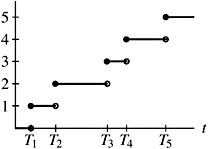
A counting process { N t, t ? 0} is a random process that counts how many times something happens from time zero up to and including time t. A sample path of such a process is shown in Figure 11.1. Such processes always have a staircase form with jumps of height one. The randomness is in the times T i at which whatever we are counting happens. Note that counting processes are right continuous.
Here are some examples of things we might count.
N t = the number of radioactive particles emitted from a...