Probability and Random Processes for Electrical and Computer Engineers

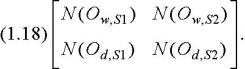
A computer maker buys the same chips from two different suppliers, S1 and S2, in order to reduce the risk of supply interruption. However, now the computer maker wants to find out if one of the suppliers provides more reliable devices than the other. To make this determination, the computer maker examines a collection of n chips. For each one, there are four possible outcomes, depending on whether the chip comes from supplier S1 or supplier S2 and on whether the chip works (w) or is defective (d). We denote these outcomes by O w,S1, O d,S1, O w,S2, and O d,S2. The numbers of each outcome can be arranged in the matrix
The sum of the first column is the number of chips from supplier S1, which we denote by N( O S1). The sum of the second column is the number of chips from supplier S2, which we denote by N( O S2).
The relative frequency of working chips from supplier S1 is N( O w,S1)/ N( O S1). Similarly, the relative frequency of working chips from supplier S2 is N( O w,S2)/ N( O S2). If N( O w,S1)/ N( O S1) is substantially greater than N( O w,S2)/ N( O S2), this would suggest that supplier S1 might be providing more reliable chips than supplier S2.