Radar Systems for Technicians
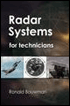
Combining historical insight and technical information, this text takes the reader as far back as original World War II concepts to illustrate the logical reasoning behind state-of-the-art radar designs.
 TABLE OF CONTENTS
 This book is intended for readers with a foundation in basic electronics, which would include amplitude modulation (a-m) theory. A radar transmitter is pulsed, but the modulation is somewhat similar to amplitude modulation exceeding 100%. In the presence of the pulse, a maximum carrier power is created, and, in the absence of the pulse, the carrier power is totally disabled. The character of the transmitted output is a very important consideration; it is determined by a-m principles, and by the harmonic content of the pulse. It is all too easy to incorrectly assume that the transmitter only emits a burst of a single frequency, which is impossible; believing such an overly simplistic concept deprives the technician of important knowledge, necessary in tuning and trouble analysis, in both the transmitter and receiver Accordingly, a review of the rudimentary principles of a-m is in order.
Figure 10 1 illustrates the effect of modulating a carrier frequency with a sine wave. Without the modulation, the c-w carrier power is indicated on a spectrum analyzer as a single spectral line. When the carrier is modulated by the sine wave, two additional frequencies are generated, (1) the carrier plus the modulation frequency, and (2) the carrier minus the modulation frequency. The carrier power remains unchanged, because the average of the modulation sine wave Voltage is zero.

It is clear, in figure 10 1, that the modulation frequency is impressed upon the carrier frequency as