Radar Systems for Technicians
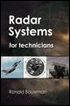
Combining historical insight and technical information, this text takes the reader as far back as original World War II concepts to illustrate the logical reasoning behind state-of-the-art radar designs.
 TABLE OF CONTENTS
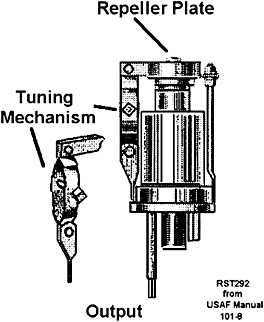
 Work on klystrons may well have preceded the magnetron; the brothers, Russell and Sigurd Varian , of the United States, had developed a two-cavity S-band klystron oscillator as early as 1937. However, these early klystrons were not high-power devices, and were not widely used as transmitter tubes. Their development, though, led to the reflex klystron oscillator, which served as the local oscillator in many early microwave radars. A reflex klystron is illustrated in figure 10 22. Reflex klystrons are still in use today, particularly in microwave link relay equipment. Klystron high-power amplifiers appeared on the radar scene in the 1950 s.
In 1940, scientists from Great Britain provided the United States with the multicavity magnetron, a 10-cm (S-band) high-power oscillator developed by British scientists Randel and Boot at the Birmingham University in England. The magnetron promptly became the transmitter tube in microwave radars for years to come, and is still in use. Compared to the power klystron, it is simple in construction and supporting equipment, and it has the advantages of low cost and economical maintenance. It has the disadvantage of lower power capability, and; because it is both an oscillator and transmitter, it is not coherent with the other oscillators in the radar system.
Figure 10 23 illustrates the construction of a magnetron built in the 1940 s. Newer magnetrons are still very similar. The cathode is located in the center of the tube, and the anode is at ground potential Within the...