Radar Systems for Technicians

Combining historical insight and technical information, this text takes the reader as far back as original World War II concepts to illustrate the logical reasoning behind state-of-the-art radar designs.
 TABLE OF CONTENTS
 In terms of science, the radar receiver may be the greatest accomplishment in the system; its surface-apparent simplicity unfairly diminishes the scientific and engineering endeavors behind it. Its purpose is simply to amplify and detect radar echoes, but that is no small challenge. Echoes are very low in power, because they have been severely attenuated by, at least, 16 ? 2R 4, from their transmission to reception, in accordance with the equation:
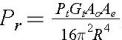
P r=Received power
P t=Transmitterpeak power
A o=Target cross-sectional area
A e=Antenna effective aperture
R=Range
The greatest limitation to the receiver s ability to amplify and detect an echo is that there exists noise, which may obscure the weaker echoes. The noise comes predominately from two major sources, (1) the movement of electrons through active circuits in the receiver, and (2) the radiation from the sun. Other contributions come from the molecular activity of heated gasses in the atmosphere, and molecular activity caused by the heating of the antenna reflector. In any case, there is a direct relationship between heat, molecular activity, and noise. The greatest noise source of all is the receiver local oscillator; since it is an active circuit, it creates noise while generating its output frequency, and that noise is injected into the signal mixer. In fact, the presence of noise, often called, grass, on radar video, is a good indicator that the local oscillator is running.
The quantity P a