Combining historical insight and technical information, this text takes the reader as far back as original World War II concepts to illustrate the logical reasoning behind state-of-the-art radar designs.
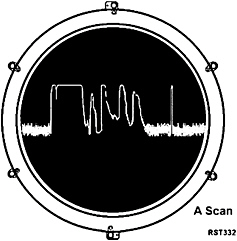
Military origin, now mostly US Navy. A cathode ray tube display, showing range, or time, versus amplitude, where range is the horizontal, and amplitude is the vertical. When used in fire-control radar, normally, the range is only a small portion of the overall range of the radar. The display is similar to an oscilioscope, and an oscilloscope display may also be called an A scope. See page 15 4.
Figure A1 1: Type A Display.
AAW:
US Navy. Anti-Aircraft Warfare. Used to describe that combat that takes place above the surface of the ocean. Various surface ship systems that support this type of warfare area that include Fire Control Radar, Three Dimensional Radar, Tactical Air Navigation and Phased Array Radar (Multi-Function Array) systems.
Acquisition Gate:
US Navy. In tracking radar, a gate defined in range and bearing, derived from two circuits, one, the azimuth change pulse, and the other, the range counter. The gate defines the coarse, two-dimensional, position of a target of interest This gate is normally used to position a smaller, and more accurate, gate called, the track gate.
AC&W:
USAF. Aircraft Control and Warning. Formerly used to describe installations containing ARSR-class long-range radars, height-finder radars, computer systems, and intercept control.
ACP:
See Azimuth Change Pulse (Acp).
Active:
Universal. Broadly, active and passive describe an electronic component that operates, respectively, with or without external Voltage, in addition to the signal passing through it. In air traffic control surveillance radar, active ...
Copyright SciTech Publishing 2008 under license agreement with Books24x7