Roll Form Tool Design

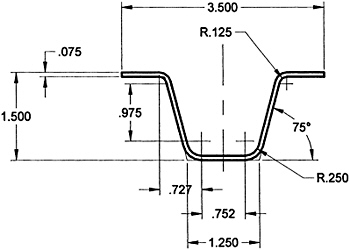
Development of the strip width for a given shape would appear to be quite straightforward ------- It is simply the summation of the calculated bend allowances, the arc lengths of curved elements, if any, and the straight lengths of the shape. As an example, the strip width will be determined for this hat section in 14 ga (.0747) hot rolled steel, Fig. 2.1:
This shape and the parent material are chosen to illustrate the impact that material tolerances have on end shape tolerances, as well as the strip width development. The commercial tolerance on thickness for 14 ga. hot rolled steel allows the thickness to vary from .068 minimum to .081 maximum. If the height dimension of 1.500 is intended to apply with the material at nominal (.075), it can vary, neglecting angularity tolerances, from a minimum of 1.493, to a maximum of 1.506, as the actual material thickness changes from .068 to .081. Obviously, if the product design sets the 1.500 dimension as the high limit with the tolerance minus, the height dimension will vary from 1.487 to 1.500. Similarly, if the product design sets the 1.500 dimension as the low limit with all the tolerance plus, the height dimension will vary from 1.500 to 1.513.
The developed width calculation is based on the nominal material thickness, but the material distribution will change as the actual material thickness changes, and this will impact the final dimensions of the shape. The developed width calculations which...