Roll Form Tool Design

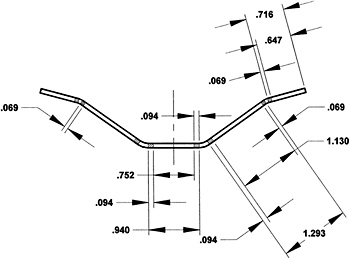
The product shape in the third pass is illustrated in Fig. 4.19, together with the bend allowance distribution from the chart in Fig. 4.8:
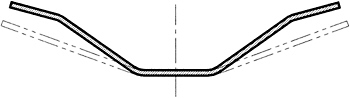
In Fig 4.21 the product shape of the third pass is shown with the incoming product shape of the second pass superimposed in phantom lines. Adding shoulder details to the roll profiles will again provide distinct advantages in terms of a smooth lead in, as well as providing stops to keep the product centralized.
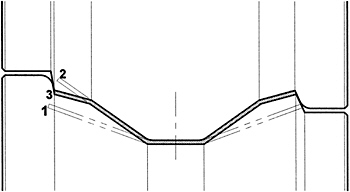
Fig 4.22 illustrates two general approaches to a shoulder detail. On the left hand side, the shoulder is on the lower roll, and the material edge is at position 1 coming out of the second pass. The edge is lifted to approximately position 2 as forming begins in the third pass, and is pushed into position 3 as the forming is completed in the third pass. The lead-in is good, but the stop characteristics of the shoulder are not quite positive. On the right hand side, the shoulder is on the upper roll. The lead-in will be quite smooth, and the shoulder provides a well-defined positive stop which will ensure that the shape stays centralized within the limits of the strip width tolerance. The third pass roll details which follow will be based on the configuration having the shoulder detail on the upper roll.
To function as a stop, the shoulder is located by the .716 dimension (from Fig. 4.19) plus .004 for the...