Roll Form Tool Design

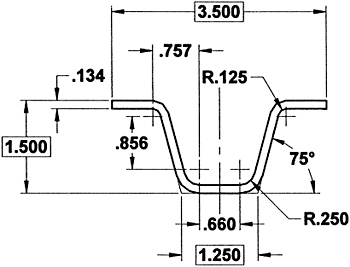
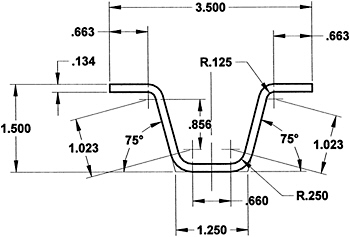
The design and progression would again have to be handled differently if the example shape were to be made from a heavier gauge material, say .1345 (10 ga.) hot rolled steel, as in Fig 6.1:
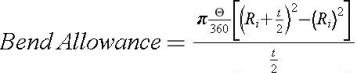
The commercial tolerance for the strip material would be .007 for the thickness, and would be .005 for the strip width. Using the bend allowance formula as before:
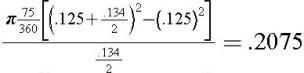
The bend allowance for the .125 radii (based on the nominal thickness .134) will be:
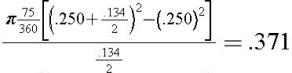
The bend allowance for the .250 radii will be:
The lengths of the straight elements are defined in Fig 6.2:
The developed width=2(.663+.207+1.023+.371) +.660=5.188
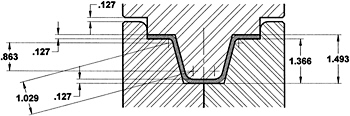
Though the product shape has the same width and height as the first example except for the material thickness, the resulting developed width of the strip material is .198 narrower. The commercial tolerance for the thickness of 10 ga. hot rolled strip is .007, so variation in the material thickness being processed will result in a much larger change in the end product than the first example made from 14 ga. When the upper roll is adjusted downward to the .127 material gap, the resulting product shape would have the dimensional changes shown in Fig. 6.3, which shows the product height down to 1.493 from the nominal 1.500:
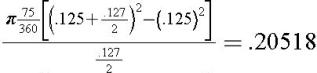
At the minimum material thickness .127, the bend allowance for the .125 radii will be:
The bend allowance at the nominal material thickness of .134 was .2075, so the...