Roll Form Tool Design

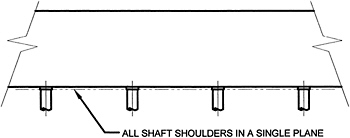
To successfully form a metal shape progressively by forming in partial steps through a series of stations requires that a reference point in the shape move in a straight line through the process. This is accomplished when the designer of the roll form tools holds a selected reference point in the shape in constant relationship to reference features of the roll forming machine. The shoulder on each of the shafts are a set of reference features which are used to accurately locate the rolls on the shafts of the machine when making the tool setup. Ideally, when the upper and lower shafts are parallel, all of the shaft shoulders should lie in a single plane, as in Fig. 3.1.
The shaft shoulder location can be defined within a single station (the shoulders of the upper and lower shafts), or it can be defined from station-to-station. Acceptable tolerances for each of these conditions are quite different. In the case of the station to station tolerance, the location of the lower spindle shoulders lying .002 or .003 on either side of the plane of Fig.3.1 is unlikely to cause any difficulty because the product part will track by being forced into position by the rolls, but this would not exceed the elastic limit of the material, which would cause a permanent distortion and deformation of the product part.
The shoulders of the upper and lower shafts of a station should be in alignment, as in Fig.