Roll Form Tool Design

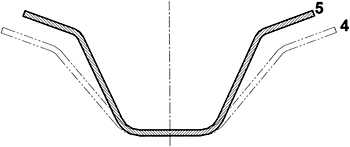
In Fig. 4.29 the product shape of the fifth pass is shown with the incoming product shape of the fourth pass in phantom lines.
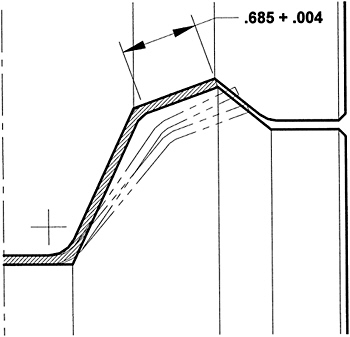
If the shoulder detail is put on the upper roll as in the previous pass, Fig. 4.30 shows that the edge might be distorted by early contact with the angular surface of the roll.
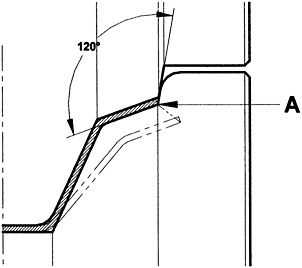
If the shoulder detail is put on the bottom roll, as in Fig 4.31, the shoulder does not provide any lead-in function, but there is some centralizing effect. As the leg rotates toward the end point of the form, the strip edge is driven into the corner A . The 120 angle is too large to function as a positive stop, but it can signal a tracking problem if one edge is distorted. It can also signal a strip width that is too wide if both edges are distorted.
Another way of putting the shoulder detail on the bottom roll is shown in Fig. 4.32. Here the lead-in appears to be good, but once forming in this pass begins, the edges of the shape would be pulled away from the vertical surfaces of the shoulders. There would be no centralizing effect on the incoming shape, and in this configuration there is no positive stop at the edges of the shape. A stop could be provided, as in Fig. 4.33, but it is important to recognize that the bends of the .250 radii are close enough...