"If architects built buildings the way programmers wrote software, the first woodpecker that came along would destroy civilization."
Unknown
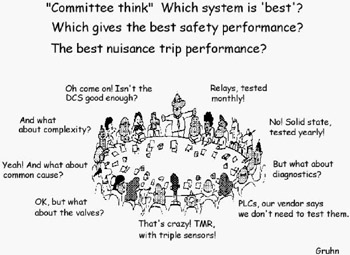
There are a number of technologies available for use in shutdown systems; pneumatic, electromechanical relays, solid state, and programmable logic controllers (PLCs). There is no one overall best system, just as there is no overall best car (vendor claims notwithstanding!). Each technology has advantages and disadvantages. It's not so much a matter of which is best, but rather which is most appropriate, based on factors such as budget, size, level of risk, complexity, flexibility, maintenance, interface and communication requirements, security, etc.
7.1 Pneumatic Systems
Pneumatic systems are still in use and are perfectly appropriate for certain applications. A very common application for pneumatic systems has been the offshore industry where systems must operate without electrical power. Pneumatic systems are relatively simple (assuming they're small) and relatively fail-safe. Fail-safe in this sense means that a failure or leak would usually result in the system depressurizing which would initiate a shutdown. Clean, dry gas is typically necessary. If desiccant dust from instrument air dryers or moisture from ineffective drying or filtering enters the system, small ports and vents utilized in the pneumatic circuits will be prone to plugging and sticking. This can render the circuits prone to more dangerous failures where the system may not function when required. Frequent operation and/or testing is usually necessary in order to prevent parts from sticking. Offshore operators in the U.S. Gulf of Mexico are required to...
Copyright ISA - The Instrumentation, Systems, and Automation Society 2006 under license agreement with Books24x7


 TABLE OF CONTENTS