Safety Instrumented Systems: Design, Analysis, and Justification, 2nd Edition

8.10: Analysis of a Relay System

8.10 Analysis of a Relay System

First, we must assume a failure rate (or MTBF) of a relay. Data books will show a considerable range of data for different types of relays. We can assume a 100 year MTBF for an industrial relay.

Next, we must consider how many relays to include in the calculation. Let's assume there will be one relay for each input and output in the system. Let's assume a relatively small interlock group, just eight inputs (e.g., high and low switches for pressure, temperature, level and flow) and two outputs (e.g., two valves). The system would suffer a nuisance trip if any of the ten relays were to fail open circuit. Therefore, we simply add the safe failure rate of ten relays. Remember that MTBF = 1/ ?. Assuming a relay is 98% fail-safe:


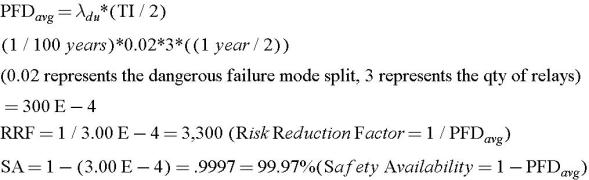
We need to break the I/O down further for the PFDavg calculation. When there is a shutdown demand placed on the system, it comes in on one input only. For example, only the high pressure shutdown goes into alarm, not all eight inputs at the same time. Also, the SIL is determined for each single function, so we should only model the PFD of a single function. Therefore, we should only include one input and both outputs in this particular model. This amounts to just three relays. Note that since a relay has no automatic diagnostics, all dangerous failures are dangerous undetected.


UNLIMITED FREE
ACCESS
TO THE WORLD'S BEST IDEAS

SUBMIT
Already a GlobalSpec user? Log in.

This is embarrasing...

An error occurred while processing the form. Please try again in a few minutes.

Customize Your GlobalSpec Experience

Category: Protective Relays and Monitoring Relays
Finish!
Privacy Policy

This is embarrasing...

An error occurred while processing the form. Please try again in a few minutes.