Safety Instrumented Systems: Design, Analysis, and Justification, 2nd Edition

8.7: Modeling Methods

8.7 Modeling Methods

"Managing lots of data begins with some form of simplification."

Megill

"The less we understand a phenomenon, the more variables we require to explain it."

L. Branscomb

There are a number of methods available for estimating the performance of systems. Some of the more common are reliability block diagrams, fault trees, and Markov models.

8.7.1 Reliability Block Diagrams

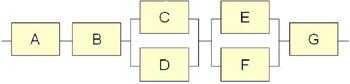
Reliability block diagrams (RBDs) are just that, diagrams. Their usefulness is in helping to clarify system configuration and operation. Figure 8-4 is an example. In this case the system would fail if A, B, or G failed. Items C and D, as well as E and F, are redundant. The system would only fail if both items C and D, or both E and F, failed at the same time. The formulas generally associated with reliability block diagrams simply involve adding or multiplying probabilities of the blocks. With the assumption that probabilities are small, one would add the probabilities of items in series (A, B and G). One would multiply the probabilities of items in parallel (C and D and E and F). In general, block diagrams and their associated math do not handle time dependent variables such as repair times, test intervals, diagnostics, and the more complex redundant systems. However, more complex formulas can be used to calculate failure probabilities of each block.


Figure 8-4: Reliability Block Diagram

8.7.2 Fault Trees

Fault trees are based on combinations of AND and OR gates. An example with...

UNLIMITED FREE
ACCESS
TO THE WORLD'S BEST IDEAS

SUBMIT
Already a GlobalSpec user? Log in.

This is embarrasing...

An error occurred while processing the form. Please try again in a few minutes.

Customize Your GlobalSpec Experience

Category: Reliability Software
Finish!
Privacy Policy

This is embarrasing...

An error occurred while processing the form. Please try again in a few minutes.