Safety Instrumented Systems: Design, Analysis, and Justification, 2nd Edition

Algebraic simplifications to Markov models have been available for decades. The theory behind the following formulae is developed in Reference [5]. Similar formulae are also shown in References [11] and [12]. These are often called "simplified equations" and are usually associated with reliability block diagrams. This is actually incorrect as the formulae can just as easily be incorporated into fault trees.
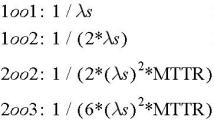
The first set of formulae are for calculating mean time to failure, spurious (MTTF spurious):
MTTF spurious formulae
where:
MTTR = mean time to repair,
? = failure rate (1 / MTBF)
s = safe failure
1oo1 stands for 1 out of 1, 2oo3 stands for 2 out of 3, etc.
The above formulae are valid when the repair rate is much greater than the failure rate (1/MTTR >> ?), or conversely when the MTBF is much greater than the MTTR. The formulae are based on the assumption that safe failures are revealed in all systems, even single channels of 2oo2 and 2oo3 configurations (e.g., through some form of discrepancy alarm). In other words, there are no safe undetected failures.
Average probability of failure on demand (PFD avg) is calculated knowing the dangerous undetected failure rate and manual test interval. The PFD of dangerous detected failures can also be calculated (using slightly different formulae), but their impact on the final answer is insignificant, usually by more than an order of magnitude. The impact of dangerous detected failures can,...