Schaum's Outline of Theory and Problems of Electronic Communication, Second Edition
Modulation is the process of imposing information contained in a lower-frequency electronic signal onto a higher-frequency signal. The higher-frequency signal is called the carrier and the lower-frequency signal is called the modulating signal. If the information is imposed on the carrier by causing its amplitude to vary in accordance with the modulating signal, the method is called amplitude modulation.
The advantage of transmitting the higher-frequency signal is twofold: First, if all radio stations broadcast simultaneously at audio frequencies, they could not be distinguished from one another and only a jumbled mess would be received. Second, it is found that antennas on the order of magnitude of 5 miles to 5000 miles are necessary for audio frequency transmissions.
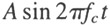
The mathematical description of the unmodulated carrier wave is
| (3.1) | |
where f c is the carrier frequency and A is the peak value of the unmodulated carrier.
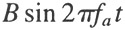
If, for simplicity, a single audio tone is taken as the modulating signal, it can be represented by
| (3.2) | |
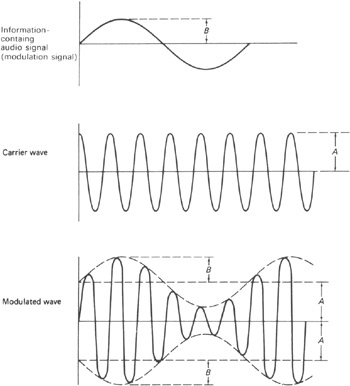
where f a is the frequency of the audio tone and B is the peak value of the modulating signal (see Fig. 3-1).
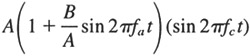
The modulated wave can be represented mathematically as the product
| (3.3) | |
where f a is the frequency of the audio modulating signal and f c is the frequency of the carrier. Factoring, we get
In terms of voltage, we have
| (3.4) | |
where V c is the...