INTRODUCTION
Frequency modulation was originally developed to cope with undesirable noise which competed with the desired signal when amplitude modulation was used. Most noise appeared as an additional amplitude modulation on the signal.
When frequency modulating a carrier, information is placed on the carrier by varying its frequency while holding its amplitude fixed. Upon being received, variations in amplitude are eliminated prior to demodulation without affecting the information content contained in the frequency variations, thereby eliminating any noise which may appear as an amplitude modulation of the carrier. See Fig. 4-1.
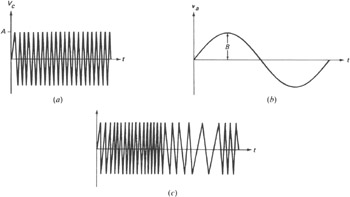 Figure 4-1
 The unmodulated carrier is described as
| (4.1) | 
|
The modulating or audio signal is described as
| (4.2) | 
|
The carrier frequency f will vary around a resting frequency f c thus:
| (4.3) | 
|
The frequency-modulated wave will have the following description:
| (4.4) | 
|
In this frequency-modulated situation, ? f is the maximum change in frequency the modulated wave undergoes; it is called the frequency deviation. The total variation in frequency, from the lowest to the highest, is referred to as the carrier swing. Thus, for a modulating signal which has equal positive and negative peaks, such as a pure sine wave, the carrier swing is equal to two times the frequency deviation.
? f = frequency deviation
Carrier swing = 2 frequency deviation
It can be shown that the equation for the frequency-modulated wave can be manipulated into
| (4.5) | 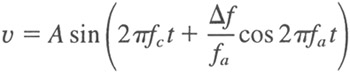
|
However, since the mathematics involved in developing this second equation depends on calculus, it will...


 TABLE OF CONTENTS