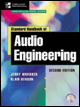
Standard Handbook of Audio and Radio Engineering, Second Edition
Intensity, duration, and repetition in time are perceptually important characteristics of audio signals. Consider, for example, speech, music, and natural and electronically generated sounds when heard by a listener. Most audio signals do have rather complicated waveforms in time, however, and these are difficult to analyze visually. The spectrum of the signal offers an alternative representation which displays the strengths of the signal's oscillating parts arranged in order of increasing oscillation. The spectrum also contains information about relative displacements or time shifts of these oscillating parts. In simple terms, the spectrum is a decomposition of the signal into several different oscillating components that later can be reassembled to re-create the original signal. All the information in the signal is contained in its spectrum, but the spectrum is a different way of representing the signal.
Frequency the number of oscillations per second, or hertz is a significant concept associated with the spectrum. Time is no longer explicitly used but is implicitly contained in the notion of frequency. A time interval, called a period and equal to the time taken for one full oscillation, is associated with every frequency, however. The period is simply the reciprocal of frequency (number of oscillations per second). A signal's overall repetitive nature as well as any hidden periodicities are revealed in its spectrum. The relative importance of the individual frequency components is also clear even though this may not...