Standard Handbook of Audio and Radio Engineering, Second Edition
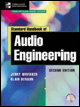
Jerry C. Whitaker, Editor-in-Chief
Standard broadcasting refers to the transmission of voice and music received by the general public in the 535 1705 kHz frequency band. Amplitude modulation is used to provide service ranging from that needed for small communities to higher powered broadcast stations needed for larger regional areas. The primary service area is defined as the area in which the ground or surface-wave signal is not subject to objectionable interference or objectionable fading. The secondary service area refers to an area serviced by skywaves and not subject to objectionable interference. Intermittent service area refers to an area receiving service from either a surface wave or a skywave but beyond the primary service area and subject to some interference and fading.
The carrier frequencies for standard broadcasting in the U.S. (referred to internationally as medium wave broadcasting) are designated in the Federal Communications Commission (FCC) Rules and Regulations. A total of 117 carrier frequencies are allocated from 540 to 1700 kHz in 10-kHz intervals. Each carrier frequency is required by the FCC rules to deviate no more than 20 Hz from the allocated frequency to minimize heterodyning from two or more interfering stations.
Double-sideband full-carrier modulation, commonly called amplitude modulation (AM), is used in standard broadcasting for sound transmission. Basically, the amplitude of an analog radio frequency (RF) carrier is controlled by an analog audio frequency (AF) modulating signal. The resulting RF waveform consists of a carrier wave...