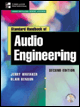
Standard Handbook of Audio and Radio Engineering, Second Edition
One of the problems with selecting a high-quality monitor system lies in the difficulty of defining quality. Some not-too-scientific descriptions may develop from discussions with other users, and even with knowledgeable authorities. Terms such as "solid bass," "smooth highs," "tight," or "clean" all may be mentioned as monitor system requirements. Trying to incorporate these subjective requirements into a working system is almost impossible. On the other hand, selecting a speaker solely on the basis of frequency response and harmonic distortion is likewise inappropriate. It is difficult to equate either scientific measurements or subjective considerations with how "good" or "bad" a particular speaker system sounds.
For the purposes of this examination, the term speaker will refer to a single transducer. Monitor or monitor system will refer to an assembly of speaker(s), enclosures and, where appropriate, crossovers and amplifiers. In fact, it might be best to consider a monitor system as having at least three major components: source driver (amplifier), transducer (speaker) and mounting assembly (cabinet).
A speaker cannot produce acoustic energy without being driven by an electronic source. It likewise requires an enclosure to properly couple acoustic energy into the listening environment in a controlled manner. Even the most expensive speaker, if set on a shelf without an appropriate enclosure, will perform poorly.
"Sound Reproduction Devices and Systems" by Katsuaki Satoh, an archive chapter from the first edition of the