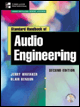
Standard Handbook of Audio and Radio Engineering, Second Edition
The audio tape recorders that first went on the air in the late 1940s were notable in their ability to store programs for later broadcast with a sound quality not available from disc recording. Nevertheless, the recorders then were extremely simple in comparison with today's machines. Even in this age of high technology, the progress that has taken place in audio tape recording is quite remarkable and may be attributed to two factors. One was the evolution in the field of electronics: transistor technology; integrated circuits and then large-scale integrated circuits first in digital and then in linear devices; digital signal processing; and microprocessors. The second was the combination of foresight and creativity applied by engineers involved in improvements in the art (and in user operations as well) in anticipating the need for improved or new capabilities, and then bringing them to pass.
Most of the advances made in the field could be classified either as further development or as innovation of methods and techniques for meeting new requirements. Neither of the categories predominated over the other in milestones. The modern digital audio workstation and digital magnetic tape recorder represent the application of highly developed scientific technologies, the result of many innovations and refinements since the invention of recording by Valdemar Poulsen in 1898. Today, many technical and business disciplines depend on the audio recorder in one form...