Standard Handbook of Audio and Radio Engineering, Second Edition
Cecil Harrison, Robert A. Surette
Jerry C. Whitaker, Editor-in-Chief
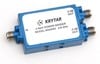
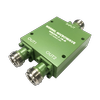
The basic purpose of an RF combiner is to add two or more signals to produce an output signal that is a composite of the inputs. The combiner performs this signal addition while providing isolation between inputs. Combiners perform other functions as well, and can be found in a wide variety of RF transmission equipment. Combiners are valuable devices because they permit multiple amplifiers to drive a single load. The isolation provided by the combiner permits tuning adjustments to be made on one amplifier including turning it on or off without significantly affecting the operation of the other amplifier. In a typical application, two amplifiers drive the hybrid and provide two output signals:
A combined output representing the sum of the two input signals, typically directed toward the antenna.
A difference output representing the difference in amplitude and phase between the two input signals. The difference output typically is directed toward a dummy (reject) load.
For systems in which more than two amplifiers must be combined, two or more combiners are cascaded.
Diplexers are similar in nature to combiners but permit the summing of output signals from two or more amplifiers operating at different frequencies. This allows, for example, the outputs of several transmitters operating on different frequencies to utilize a single broadband antenna.
A filter is a multiport-network designed specifically to respond differently to signals of different frequency [1]. This definition excludes networks, which incidentally...