Sustaining Continuous Innovation Through Problem Solving

This section reviews some basis statistics. Although people shudder at the word, statistics are fairly simple once you understand the concepts. The subjects covered in this section include:
Mean
Histograms and distribution curves
Variance and standard deviation
Normal distribution
For this section, we are going to use the following data. Assume that they are measurements for the length of a pipe coming from a production line.
Sample measurement data
| Number | 1 2 3 4 5 6 7 8 9 10 11 |
| Length | 5.8 6.0 6.1 5.9 6.2 6.1 6.1 5.7 6.2 6.0 5.9 |
Statistics can be used almost everywhere. In the process management methodology, statistics are never used alone. They are used as part of the other tools described in this manual. Other tools that use statistics are:
Control charts (SPC)
Pareto diagrams
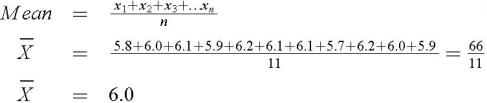
The mean is the average value of a group of measurements. Here, the mean is equal to the sum of the measurements, divided by the number of measurements. It is represented here by the symbol "
". Using the measurement data from the pipe length example:
Histogram
A histogram is a way of plotting data to show the frequency that certain points of data occur. It is prepared in the following way:
Sort the set of data measurements in ascending order. Group the measurements (if necessary) into ranges.
Determine the number of occurrences of each measurement point or group.