Sustaining Continuous Innovation Through Problem Solving

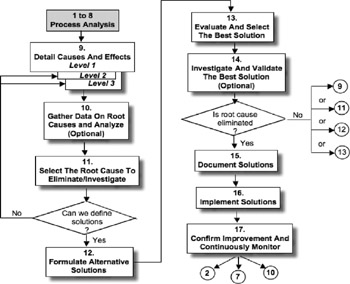
Part 2 focused on analyzing the status quo continuously and presented eight steps to analyze the "As Is" processes to sustain innovation. Part 3 (Chapter 5) presents Steps 9 to 17 of the Process Management Methodology. The focus of this chapter is a) the steps that determine what is causing below-standard performance and b) the design and implementation of solutions that eliminate or reduce the effect of those causes. Aclosed loop feedback system is employed throughout the methodology.

This is the first substantial step toward improving the process. It is here that the team makes its first formal analysis of the reasons that the process is not performing at standard or to new standards. The completeness and organization of the analysis will directly impact the success of following steps.
The tool most commonly used is Cause and Effect Analysis. The idea here is that every effect has a number of causes that can be isolated. For example, in a distribution company the effect "high number of warehouse shipping errors" can be the result of causes such as "wrong quantity counted by shipper" or "wrong quantity keyed in."
This step gets the team to brainstorm a list of causes of the performance gap. It is important to understand that any cause that may be suggested by a team member might not be the basic root cause. This cause may in turn be the result...