System-in-Package RF Design and Applications

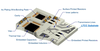
Laminate substrates have been the mainstay for the low-cost, high-volume wireless industry. These substrates allow inductors to be embedded for substrates of two or more layers [10]. Typically the bottom of the substrate is a solid ground plane, to established a controlled impedance independent of the mating board.
Inductors and capacitors on the top layer must be designed for an overmold dielectric over the top of the inductor trace. However, capacitors are typically not embedded in the laminate due to their relatively thick layers, low relative permittivity, and large, 65-micron lines and spacing for interdigitated capacitors. Capacitor density is limited to 0.44 pF/mm 2 for a parallel plate topology with a 40-micron-thick substrate. This is the thinnest laminate substrate in a package. Fortunately, this is an acceptable trade-off. Inductors cost typically three times the price of discrete capacitors; however, this mulitplier can range from 1.25 to 9. In addition, resistors are usually less expensive than capacitors, which makes inductors the prime choice for embedding in a low-cost, high-volume wireless application. However, when discrete components shrink in size, the smaller values are targeted first. The first 0201 EIA size capacitors only provided values up to 10 nF, but most designs utilized 0.1- F capacitors for supply bypassing. This required 0202 EIA size capacitors. The ultimate in size reduction would be to embed the ceramic within the laminate.
There are two methods to embed large-value capacitors within the laminate. The first aims at higher-permittivity ceramic, and the second utilizes...