This appendix discusses shielding theory basics, as related in Figure 4.2. The material is taken from [6] in Chapter 4, with slightly different wording and in a slightly different order than in the reference book. In this reference, shield effectiveness results from three terms with the following simple equation,
| (A.1) | 
|
where A is the absorption loss in the shielding material, R is the reflection loss due to the interface between the shielding material and the medium that contains it as well as different layers of shielding material, and B results from multiple reflections within the shielding material or bouncing-around loss. The definition for reflective loss is purposely written generically here since usually the medium that contains the shielding material is air in most books and electromagnetic analysis, but with packaging the medium is the dielectric overmold material for embedded shields.
The first term in (A.1), the absorption loss, results from skin effect, which describes the current density in conductors as frequency increases. The majority of the current is on the surface of the conductor, and it diminishes by approximately 2/3 to approximately 1/3 of its surface current values at one skin depth. The actual amount at one skin depth is e ?1 of the surface current value, or 0.367879. This continues to diminish by another 2/3 to approximately 1/9 of its surface current value at 2 skin depths. The absorption loss is hence given by decibels,
| (A.2) | 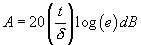
|
where
| (A.3) | 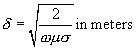
|
or
| (A.4) | 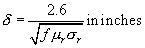
|
where f is frequency,
Copyright Artech House, Inc. 2007 under license agreement with Books24x7


 TABLE OF CONTENTS