System-in-Package RF Design and Applications

In the past, LTCC modules required a lid, which was typically metal to provide shielding [25]. However, the main purposes of the lid are to provide an area for marking, a contact area for pick and place, and protection. Unfortunately, the lid does not form a hermetic seal that will protect the die. A more expensive dam-and-fill or glop operation, discussed in Chapter 3, is required for die protection.
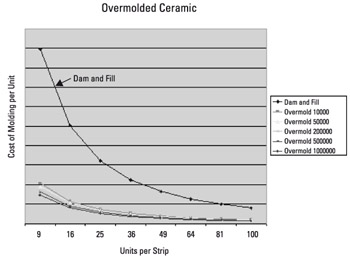
Early efforts used a dam-and-fill technique for the entire LTCC panel as a form of overmold. A dam was laid around the outer perimeter of the LTCC panel beyond the module area. This was cured, and then the liquidous fill material was added. This material shrinks as it cures, which causes the LTCC to warp and lose co-planarity. Recent events have produced true low cost overmolded LTCC with acceptable warpage [26]. This significantly reduces the cost of the overall LTCC module as depicted in a scaled comparison of overmold costs versus dam and fill costs that is shown in Figure 4.17 [27]. An approach similar to laminates is applied where four quadrants or LTCC panels are overmold in one strip (see Figure 3.1) [28], with each quadrant a similar size as a laminate quadrant to utilize the same equipment set.
Singulation is also a concern for overmolded LTCC modules. A saw works well for laminate modules, but LTCC modules are brittle and more difficult to saw. A full saw...