Torsional Vibration of Turbomachinery

Including application case studies and in-depth interpretation of computer-generated results, this book offers practical answers to preventing excessive damage, failure and noise due to vibrations in machines.
 TABLE OF CONTENTS
 It is widely recognized that the rate of free decay of turbine-generator torsional oscillations following removal of all stimuli (forcing functions) is very small. Torsional damping for turbomachinery is generally very low in comparison to that of bending vibration because significant damping for the latter is obtained through bearing journal radial motion that compresses the bearing oil film, and this radial motion is practically nonexistent for torsional vibration.
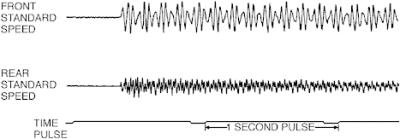
Modal damping values have been measured on several turbine-generator designs in service, confirming in each case extremely low modal damping.6 ,7 Figure 4.1 shows measured values of torsional mechanical response at each end of a turbine-generator following a transient electrical disturbance to the generator. It is seen that there is a very low decay rate of the response envelopes over about a 2-second time interval following the disturbance. The mechanical signals in this case are from toothed wheels with magnetic sensors that detect variations in the rotational velocity of the machine from its steady-state value.
Modal damping values (either estimated or measured) can be used directly in vibration analysis by writing the forced response equations in modal form. Fortunately, using modal transformation, it is unnecessary to try to deduce from measured data the values of discrete dashpot constants between shaft spans and from rotors to ground. Modal transformation is illustrated in detail later in Chap. 8.
Most modern vibration programs are structured to handle modal damping inputs directly. The modal transformation...