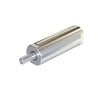
Torsional Vibration of Turbomachinery

Including application case studies and in-depth interpretation of computer-generated results, this book offers practical answers to preventing excessive damage, failure and noise due to vibrations in machines.
 TABLE OF CONTENTS
 A uniform solid-steel shaft of cylindrical cross section is built in at one end and has a very short steel impeller at the other end, which has a polar moment of inertia of 1000 lb in 2. The steel shaft is 100 in in length and 5 in in diameter. The density and rigidity modulus of steel for this example are 0.283 lb/in 3 and 1.1538 10 7 lbf/in 2, respectively.
How should this system be best modeled to determine its first five torsional natural frequencies using the finite elements defined in this book?
How can the adequacy of the model be confirmed?
What are the natural frequencies?
If a new material was used for the shaft and the impeller, how would the frequencies change?
Solution to Case Study 9.2.1
1. The shaft should be modeled as a series of distributed finite elements (preferably with three nodes per element), and a point inertia should be used to represent the short impeller. The fixed-end condition can be simulated by placing an artificial point inertia of very high value relative to the total inertia of the system (e.g., 10 8 lb in 2). In this case the rigid-body mode calculated at 0 Hz is fictitious. All other modes will have virtually zero displacement at the fixed end, representing a nodal point for the simulated built-in end condition. The...