Torsional Vibration of Turbomachinery

Including application case studies and in-depth interpretation of computer-generated results, this book offers practical answers to preventing excessive damage, failure and noise due to vibrations in machines.
 TABLE OF CONTENTS
 Rotating turbomachinery usually consists of several rotors that are connected in tandem by couplings. Usually the rotors are made from steel forgings with circular cross sections of varying diameters that are either solid cylindrical or hollow annular in shape.
Generally the main-body regions of an individual rotor have significantly larger-diameter sections than do the rotor extensions at each end. These shaft extensions often contain the seals and bearing journals and may terminate with integral or shrunk-on couplings.
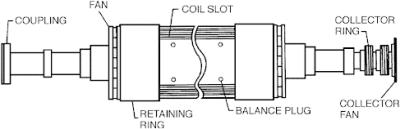
Some rotors may have rings or wheels that are shrunk on to the rotors for supporting components such as fans, or in the case of most large generators, retaining rings that support electrical conductors and insulation at each end of the main body of the generator. On some machines the wheels or rings (not the retaining rings) may be integral parts of the rotor forgings and are produced by machining operations. This may result in large, abrupt diameter changes to produce, for example, integral rings for turbine blade attachment purposes, couplings, and so on. Figure 5.1 schematically illustrates some of these features on a generator rotor.
For some rotors, the cross sections of the main body or shaft extension may not be either cylindrical or annular. A prime example would be the cross section of the main body of a large generator rotor which has deep slots machined axially down the length of the rotor as shown in Fig. 5.2...