Torsional Vibration of Turbomachinery

Including application case studies and in-depth interpretation of computer-generated results, this book offers practical answers to preventing excessive damage, failure and noise due to vibrations in machines.
 TABLE OF CONTENTS
 It is truly remarkable that by having a thorough understanding of such a simple system, many difficult aspects of machinery vibration can be understood. In part this is because complex systems respond in a combination of individual modes, and each one can be represented by an equation of the same form as for a single-degree-of freedom system. Modal analysis is based on this fact.
Figure C.1 shows a single-degree-of-freedom system involving a torsional spring of stiffness k that is built in at one end and has an inertia I at the other end. The inertia of the spring is assumed to be zero. A sinusoidal torque of amplitude T and frequency ? acts on the inertia, and ? is the corresponding rotational vibration displacement.
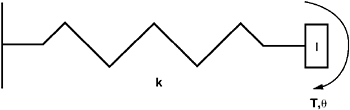
The equation of motion is
| (C.1) |  |
where  . Ignoring for the moment any initial vibration transients from application of the torque, the response frequency will be the same as the excitation frequency and the vibration amplitude will become constant.
Hence, utilize a harmonic solution of the from  , which, after double differentiation and substitution into Eq. (C.1) and grouping terms, yields
  . Therefore
| (C.2) | 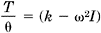 |
By definition, T/ ? is a stiffness term and is often referred to as the dynamic stiffness of the system. As expected, at zero stimulus frequency ? = 0 the dynamic stiffness equals the static stiffness of the system k.
where  , it is seen,...