Torsional Vibration of Turbomachinery

Including application case studies and in-depth interpretation of computer-generated results, this book offers practical answers to preventing excessive damage, failure and noise due to vibrations in machines.
 TABLE OF CONTENTS
 This appendix derives some of the fundamental torsional parameters used in the text, including the derivations of the results shown in Table 6.1.
The polar moment of inertia of a point mass m located a distance r from the rotational axis is expressed by mr 2.
Figure B.1 shows the cross section of a uniform shaft with an annular cross section. The internal and external radii of the shaft are R i and R o , respectively. The radius of an elemental annular ring is r and the ring s elemental thickness is ? r.
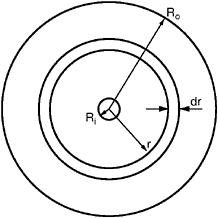
If the shaft has a length of L and a density ?, then the mass of the annular element is 2 ? r ?r Lp. The shaft s polar moment of inertia is by definition the product of the elemental mass times the square of its distance to the polar (rotational) axis r. Thus the shaft s polar moment of inertia = 2 ?r 3 ?r L ? .
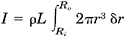
The total polar moment of inertia of the uniform shaft segment is obtained by integration of the elemental value from the inner radius to the outer radius of the shaft, giving
Therefore  Hence
Hence  where D i and D o are the inner and outer diameters, respectively.
Figure B.2 shows the outside surface of a short segment of cylindrical shaft...