Ultra-Wideband Positioning Systems: Theoretical Limits, Ranging Algorithms, and Protocols

Chapter 4: Position Estimation Techniques

Overview

After the investigation of UWB signals and channel models in the previous chapters, this chapter focuses on position estimation techniques from a UWB perspective.

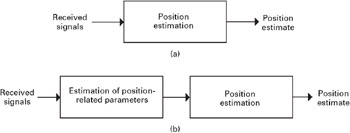
In order to estimate the position of a node (called the target node) in a wireless network, signals are exchanged between the target node and a number of reference nodes [135]. [1] The position estimation can be performed directly from the signals traveling between the nodes, which is called direct positioning [137], or by a two-step approach in which certain parameters are extracted from the signals first, and then the position is estimated based on those signal parameters (Fig. 4.1) [136]. Although two-step approaches are suboptimal in general, their complexity is lower than the direct approach. Also, the performance of the two is usually very close for sufficiently high SNRs and/or signal bandwidths [137, 138]. Therefore, most practical systems adopt two-step approaches, which will be the main focus of this chapter.


Fig. 4.1: (a) Direct positioning, (b) two-step positioning (with kind permission from Springer Science and Business Media) [135].

In the first step of a two-step positioning technique, signal parameters, such as received signal strength (RSS) or time-of-arrival (TOA), are estimated. Various types of signal parameter measurements (estimation schemes) are studied in Section 4.1. Then, position estimation from signal parameters is considered in Section 4.2. In the case of constant monitoring of a node position, position tracking algorithms, such as Kalman filtering, can improve accuracy of position estimates. Tracking algorithms...

UNLIMITED FREE
ACCESS
TO THE WORLD'S BEST IDEAS

SUBMIT
Already a GlobalSpec user? Log in.

This is embarrasing...

An error occurred while processing the form. Please try again in a few minutes.

Customize Your GlobalSpec Experience

Category: Autofocus Systems
Finish!
Privacy Policy

This is embarrasing...

An error occurred while processing the form. Please try again in a few minutes.