Ultra-Wideband Positioning Systems: Theoretical Limits, Ranging Algorithms, and Protocols

Detecting the first signal path requires intelligent signal processing techniques and the related literature dates back a few decades. One of the earlier works by Coppens develops a technique for picking of first arrivals, which operates well at high signal-to-noise ratios (SNRs) [212]. Vidal et al. develop first arriving path detection techniques using generalized likelihood ratio tests (GLRTs) and minimum variance (MV) estimators in [213 215] for cellular systems. Techniques based on minimum mean square error (MMSE) estimation [216], least squares (LS) estimation [217], and maximum-likelihood (ML) estimation [218] of the signal arrival time are also available in the literature. These techniques are mostly developed for relatively narrowband systems. However, large bandwidths of UWB signals introduce additional challenges.
Coarse timing of a received signal can be obtained by acquisition and by locking onto the strongest MPC [219]. The acquisition performance of IR-UWB systems for coherent receivers [219, 220], differential/dirty-template receivers [221 224], and non-coherent receivers [219, 225, 226] have been studied in the literature. After acquisition and coarse synchronization, refinement of the arrival time requires some processing gain to improve the SNR first, and then signal processing to detect the leading (i.e. first) path (see Fig. 5.2). As discussed in Section 5.2.1, this first path may not be the strongest component.
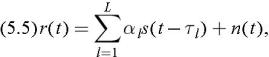
In order to define a ranging problem and develop a framework for a ranging system, let the received IR-UWB signal in a multipath environment be represented as follows:
where s( t) represents a ranging...