Ultra-Wideband Positioning Systems: Theoretical Limits, Ranging Algorithms, and Protocols

Consider a UWB ranging system that uses the second derivative of the Gaussian pulse shape given in (2.5) with a pulse duration of 2 ns. Let the TOA be uniformly distributed within [0 , 200] ns.
Calculate the CRLB and ZZLB on the MSE of the TOA estimate at SNRs of 2 dB, 12 dB, and 22 dB.
Repeat part (a) for a pulse duration of 0 .2 ns.
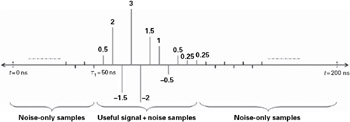
Solve questions 2 ? 5 based on Fig. 5.21 .
Fig. 5.21: Consider a UWB receiver which samples a received signal at a sampling period of 1 ns (e.g. using an MF, an ED, or a TR receiver). The receiver assumes that the TOA of the received signal is uniformly distributed in [0, 200] ns, and the true TOA of the signal is 50 ns. The channel coefficients are given by ? = [0.5, 2, ? 1.5, 3, ? 2, 1.5, 1, ? 0.5, 0.5, 0.25, 0.25] as illustrated above. For simplicity, let each of the samples be subject to AWGN with mean 0 and variance 0.01.
Consider a threshold-based detector which first stores all the samples starting from the first sample at t = 0 ns in a vector. It then compares the absolute value of each sample with a threshold starting from the first sample, and chooses the first threshold-exceeding sample as the leading edge of the signal.
Plot a realization of the...