Ultra-Wideband Positioning Systems: Theoretical Limits, Ranging Algorithms, and Protocols
Fundamental bounds such as the CRLB and the ZZLB can be used to find a lower bound on the ranging accuracy of UWB signals. However, these bounds may be very difficult to achieve with practical estimators. Both the CRLB and the ZZLB discussed in the previous section assume perfect knowledge of
or its probability distribution; such information may not be available in practice.
Maximum likelihood (ML)-based estimators may achieve accuracies that are close to fundamental lower bounds provided that certain a-priori information is available. In this section, different ML-based ranging techniques are described with varying a-priori information requirements.
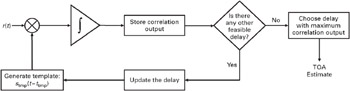
The TOA can be estimated optimally by using an MF that is perfectly matched to the received multipath signal, and choosing the time delay of the template that maximizes the correlation output (see Fig. 5.12)[142, 243]. The optimal template can be defined as
However, this optimal receiver is not possible to implement in practice since the received waveform has unknown parameters to be estimated. In particular, the nuisance parameter vector
and the pulse shape at each MPC (which may be different from the transmitted pulse shape in practice) have to be available. Therefore, the optimal correlation template cannot be obtained in practice.
Alternatively, the transmitted waveform itself can be...